Showing posts with label Artistic Differences. Show all posts

Friday, December 7, 2012

Christmas Drawing

There's a good solid chance that you won't believe this story.

Every year for years now sometime in December we've trucked up into the mountains of Pennsylvania for the Ritchey family Christmas party. My wife's parents, aunts, uncles, cousins and all that kind of thing.

I don't exactly relish it. But it's not terrible. The setting is usually very pleasant and the food is very good and her aunt's all make their Christmas cookies. The kids have a great time and usually end up getting gifts.

There's just really not much for me to do there.

Her uncles and cousins gather around the television set, tune it in to whatever football game is blah blah blah I just got bored even typing that out. And if they're not all deadly-quiet watching football, then they're talking about hunting.

I have a wide range of interests. Sorry... that's a little inaccurate. I have a narrow range of interests that happens to spread across a wide range of decades. At any rate, the point is that football and hunting aren't in my wheelhouse.

So I slink off to one of the comfy chairs in the corner, pull out the trusty iPad, and read.

Problem is, it's warm and toasty and we've been in the car for awhile and I get sleepy. Also, the sounds of football illicit childhood memories and headaches. Mostly headaches. Whether you love football or don't, you have to admit that the background noise it gives off is not... pleasant. The situation isn't always reading-ideal.

So last year I decided I would broaden my spectrum. Instead of reading so much, I'll try drawing! I used to draw all the time as a kid and studied art in high school, so why not use the iPad (amazing tool) and try my hand at drawing again?

I can even make it a Christmasy/comic booky theme and try to bolster my ailing holiday spirit!

I drew this:


It was after we got home, after I had excitedly emailed my pic out to all my friends and family, that I suddenly remembered why I was having this deja vu feeling so incredibly strong.

I had done exactly the same thing last year.

No no... exactly the same.

This is the pic I drew the year previous:


Same situation. Same party. Same rational. Same isolationist tactics. Same character. Same bag of presents. Same damn Santa hat. Probably the same staggeringly-boring football game!

Really? Am I THAT small minded?

I was in the midst of beating myself up for being a one trick pony when my father replied to my email.

"Last year he was carrying the bag over his right shoulder."

...

Heavy sigh.

Thanks,
DCD

Friday, August 24, 2012

Trying to talk about Jack Kirby

I want to write to you about Jack Kirby. But I’m a little nervous about it and I don’t know where to begin. It's like that for the things I'm most passionate about. Like my first post about Aquaman. Jack Kirby is... I have the greatest amount of respect for not only his body of work but for the man himself.


Jack Kirby was a major participant in creating the Marvel universe. But more than that, Kirby created a whole method of storytelling within comics. He was extremely influential, very prolific, and had an overwhelming imagination. Unfortunately, he was also a humble guy that didn’t believe in self promotion. Unlike Stan Lee.

So who gets billed today with creating the Marvel universe?

This subject has been covered elsewhere and in greater detail by much more professional men than I. Volumes and volumes have been written about both men, and the history of comics and their creators is much better covered in that material. That’s not the purpose of this blog. My purpose has to remain within my own, historically colored, perspective.

The webcomic strip XKCD recently had a strip that encapsulates my whole concern here. We’re going to forget! If we’re not careful, we’ll forget. I have no idea why, but that scares me to pieces! Even right now, because of the Marvel movies and other things, everyone knows who Stan Lee is. The non-comic people in my life always ask me about or mention Stan Lee. None of them have ever heard of Jack Kirby. Which is wrong. And I guess that’s why it scares me. A deep need to set right that which is wrong.


But there’s no correcting that. There's a chance that Jack Kirby will end up a forgotten note in American History. As far as popular culture is concerned, Stan Lee created the Fantastic Four, the X-Men, the Avengers, Spider-Man and many great Marvel characters. People like Jack Kirby and Steve Ditko will slowly fade into the realm of footnotes.

Another webcomic I read, PVP, had an excellent blog post dealing with the fact that the characters portrayed in current-day Marvel are far from the ones that Kirby created in the 1960’s. They’ve been updated and re-updated to the point to be almost unrecognizable.

I started recognizing different artistic styles very early on. I read and re-read and poured over the comics I had until I had memorized every panel. Marvel comics ‘felt’ different to me from DC. I did and still do prefer DC, but that doesn’t mean I hate Marvel. Far from it. But when I picked up something drawn by Jack Kirby, I knew I was looking at a Marvel book. What I was seeing was mostly reprints of old Fantastic Four and Captain America stuff, but I didn’t know that then. And Kirby had been working for DC by the time my comic-love brainwashing had really set in, but I didn’t know that either. In fact, I had a Kirby-drawn issue of Kamandi that I stored with my Marvel comics because the style of drawing had me convinced that it wasn’t from DC.


Just one page from that childhood Kamandi issue.


Curt Swan Superman looked very stiff in comparison.


King Kirby gets moody with one of the all-time great Thing stories.


My personal favorite artist is Dick Dillin. But that’s firmly rooted in nostalgia and upbringing. Dick Dillin was THE Justice League artist of the1970’s, and that was that.


Dick Dillin drawn classic JLA splash page.


My appreciation for Kirby artwork grew over the years. He made the Fantastic Four come alive. I had other FF stories drawn by other artists of the seventies. In fact, my first introduction to George Perez artwork was in a Fantastic Four comic that ended up being one of my all-time favorites. But still, it’s like watching them on TV when you first saw the same characters on the movie screen.


George Perez drawn childhood FF issue. It's always more dynamic in my memory than it actually is.


Kirby pencils popping off the page like a 3-D movie. Stared at this for hours as a kid.


Will Jack Kirby be remembered? There’s a magazine devoted to him put out by the great people at TwoMorrows and many books and articles have been written about him. But the eleven-year-old kid of Lorie’s best friend knows all about Stan Lee because he pops up in the movies. She’s never heard of Jack Kirby.

There’s something else that's bothering me…

We all ache to be remembered after we’re gone; to achieve some element of immortality. Here it is 46 years after Kirby brought the Fantastic Four to their greatest moments and 18 years after his death, and our culture has started to forget him. If people can’t remember the game changing genius that was Jack Kirby, well then what hope do the rest of us have?


Thanks,
DCD

Friday, July 13, 2012

Flashing through the Decades

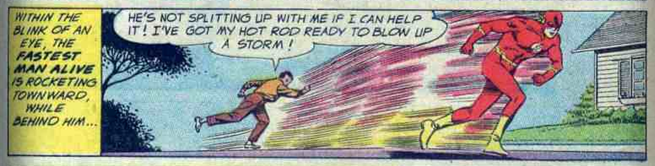
Last Friday I posted something talking about the Flash and the different artists that worked the book in the 1970's and 1980's. The post was mainly about the art and I had hoped to pull off something fancy by showing a similar theme, in this case the Flash running, and how different artists depicted it. One artist would use speed lines and one would use different 'after images' of the Flash and one would just get crazy with it the older he got.

My twelve-year-old son Ashton didn't get it.

"I didn't like today's blog, Dad." He started. In all unfairness, he hasn't liked any of my blogs yet. I don't think he likes the idea of me blogging. "I get that you were trying to show the different artists on Flash, but you should have talked about the things that made them different."


Fair enough. I thought I was writing a little too much, and a more visual post would break the routine. Still feeling my way around this blog thing. However, last week's post was just a primer for this post.

As I said last week, I recently finished a re-read of the Flash. Every appearance outside of the Justice League for the Barry Allen version of the Flash, from 1956 to 1985. I enjoyed it immensely, as these straight-runs are a thing for me. And this Flash will always be the true Flash for me. I think that sort of thing is determined by one's childhood.


Much has been said about how Superman and Batman have been able to change themselves over the decades to appeal to the widest audience possible. Superman going from the anti-authority figure in the 1930's, Nazi fighter in the 1940's, super authority figure in the 1950's, and ending up a thorough square in the 1960's. A little lost in the culture. Once you've hit 'super authority figure', it's hard to come back from that with the hippies. But he did.

Not much has been said about other heroes. They don't change as much. Probably because they don't stretch out into other media as much as Superman and Batman do.


Barry Allen started out in the fifties with a crew cut and very much an authority figure. He was a police scientist, working the forensics before it was cool. It took him until the early seventies to get a new haircut. But his personality was always very stiff. I've come to see him second only to Superman in his staunch beliefs on right and wrong.


What's most interesting to me here is how the book changed over the decades. There were only a few main writers for the Flash. Robert Kanigher and John Broome got things started in the 1950's. Gardner Fox joined them for some stories in the early 1960's. And Frank Robbins took over in the late 1960's with some stories by Mike Friedrich. But all these stories were very plot-driven. Done-in-one stories usually heavily routed in science fiction. It was obvious these guys had a story to tell, the Flash character and setting were just the tools to tell it.


Cary Bates wrote his first Flash story in May of 1968. He was the first Flash writer who grew up as a fan of the character. He wasn't telling stories that just happened to have the Flash in them. He was definitely writing the Flash. He took over the book as regular writer in 1973. He continued as regular writer for the Flash until the book was cancelled in 1985. For the decades of the 1970s and 1980s he controlled the Flash's destiny. And these stories were very different between the two decades, despite having the same writer.


This is the first time one of my re-reads has turned up something like this. Usually such a dramatic shift in story is because of a different writer coming in. In this case, I think it was editorial direction.


In the 1970s, Bates wrote short, action packed, done-in-one-issue stories. Conflict was the main thrust of the story, rather than plot. Not violence by today's standards, but definite action. These were obviously reaching out to a young audience of bike-riding kids at the 7-Eleven looking for something fun to spend their thirty-five cents on.


In the 1980s, Bates' stories changed drastically. He started adding more drama, and the stories started stretching over multi-issue story arcs. The Flash's wife died, right after they decided to start having kids. The Flash took several issues to find out who the real killer was and resolve the murder. He moved, got neighbors and new supporting cast members, started to actually be depicted at his job at the police station, and started to date. Then, after meeting and romancing another woman, he was about to marry again when the same villain who murdered his first wife showed up and tried to do it again. During the ensuing battle, Flash snapped the villains neck and killed him instantly.


The trial of the Flash was unprecedented in comics, stretched over two years or so, and turned out to be quite boring. I give Bates props for the ambition. If he was being told to ramp up the drama, he did that quite a bit.


These stories were not written for the casual reader. They were written for the repeat buyers showing up in the new comic book stores that had started to pop up. These customers were a little older than the bike-and-convenience-store crowd.


It was neat to stumble upon this example of the comics actually trying to change themselves to meet the needs of their greatest comic audience. However, I do believe this ultimately led to their downfall. In the 1940's, comics were for kids and sold everywhere and a single issue could sell in the millions. Today, finding comics appropriate for kids is tough, they're only sold in specialty shops, and the companies are happy with book that sells in the tens of thousands.

It's more complex than that. With price and competing entertainment factoring in. All I know is that I miss being able to hop on my bike and peddle down to the 7-Eleven to see what's on the spinner racks and maybe get a piece of candy for the bike ride home.

Thanks,
DCD

Friday, July 6, 2012

Artistic Differences - Flash

Folks,

One of the series that I want to run on this blog is a look at how a particular character can be vastly different depending on the decade in which he's depicted.  Superman and Batman are the clear leading examples, and much has been written about that.

But other than attitude and depiction, there's art.  While I'm not an artist, I am highly intrigued by art and different art styles.  I began to recognize different art styles at a very early age.  When I realized this guy 'Kirby' made things look different from EVERYONE else.

I've also just completed a read of the Silver Age Flash, Barry Allen.  Every appearance from the first in 1956 to the last issue of his series in 1985.  It was fun, and I love reading a character straight through like that.  But with the Flash, the differences between the different decades was made quite apparent to me.

I'll get to that later.  For now, let's check out some art.  Just for fun.

Flash had five different main artists on his book from 1956 to 1985.  His originator, Carmine Infantino.  Carmine's successor Ross Andru.  My favorite and the artist I associate with Flash from my childhood, Irv Novick.  Don Heck, who I recognize as a classic but has never been one of my favorites.  And then in the 1980's, Carmine Infantino came back again.  This time with a looser style and much more confidence, having been DC's editor in chief in the meantime and probably having hired the editor that was overseeing him.

Carmine's pencils are widely recognized as one of the industry greats.  I love his stuff from the sixties.  As a kid, I wasn't too fond of his Spider-Woman or Star Wars work in the seventies.  And as a teenager in the eighties I had no appreciation for Carmine at all.  I guess I just didn't have the perspective I have now.  But the 1980's were all about George Perez, John Byrne, Keith Giffen, and Jerry Ordway for me.  Highly detailed artists.  Carmine is more fluid.  And if he has the wrong inker, he was a mess.

ANYWAY... just my opinion.  Here are some shots.

Carmine Infantino; 1965


 Ross Andru; 1968

 Irv Novick; 1978

 Don Heck; 1981

Carmine Infantino; 1983

Other artists had a crack at Flash when he made appearances in the Brave and the Bold and, of course, Justice League of America.
Neal Adams; 1968
Jim Aparo; 1976
Mike Sekowsky; 1960
Dick Dillon; 1979
George Perez; 1981


Thanks,
DCD