Showing posts with label Flash. Show all posts

Friday, July 20, 2012

My Obsession with Spreadsheets

Among my many weakness is my love of a good spreadsheet.

There's something about putting data into an orderly fashion into little columns and rows in electronic format that just speaks to me. I love it. Maybe it's something about my job as a computer programmer or my database organizational training. But I think it's much deeper than that and comes part-and-parcel with being OCD.

My earliest memory of being a little too obsessed with organization comes from the summer of 1978. I was playing cars with the neighborhood kids, one of those rare instances when I agreed to play something other than super-heroes, Star Trek, or Star Wars. It was my box of toy cars and my porch, so therefore it was my rules. I couldn't quite decide on the division of the cars and the setting and circumstances in which we would play. One of the other kids asked me "Can we stop getting ready to play and just play?". That was a ridiculous notion and I told him as much. A few minutes later, I ended up playing alone.

At some point when we lived in Rochester, New Hampshire between 1979 and 1981, I got my hands on my Father's typewriter. My sister played with it for a few minutes and completely lost interest. But I remember sitting and working for awhile on a list of super hero names categorized under the teams in which they belonged. The experience was at once both pleasurable and frustrating, as I kept making mistakes and having to start over.

The ability to enforce order out of chaos is kind or rare, I think. Fifteen years ago, my Assistant Manager at Blockbuster marveled at the way I would storm in on a busy Friday afternoon, make a pile of all the chores he couldn't quite get done, and begin delegating tasks until the pile was gone. My distrust manager loved my "task clipboard", where I hand drew a grid and mapped out through the following week which member of the management team was to perform which task and on what shift. Other store managers thought it was way over the top. My assistants loved it, clearly knowing their expectations in advance. It was my first spreadsheet, before I actually had access to a computer.


This is my 'spreadsheet' of k-cups. Lorie was in charge of the k-cup drawer for about three minutes.

I've begun to create spreadsheets for no other reason than to get my overly-active brain to calm down for a few minutes. Compiling data on my various hobbies in a way I hadn't thought of before. It helps me when I'm really angry about something to just calm down and focus on something simplistic, monotonous, and structured.

Let's look at the spreadsheets on my iPad at this particular moment in time. I have 59 spreadsheets.

9 spreadsheets are in the "old" folder and no longer viable.
18 spreadsheets are dealing with comics in some way.
4 spreadsheets I use with the kids and parenting.
4 spreadsheets are for Ashton alone.
4 spreadsheets for music (remind me to tell you about my crazy iPod playlist habits sometime).
3 spreadsheets tracking my obsession with toys.
2 spreadsheets that help me with the budget.
2 spreadsheets for Christmas.
2 spreadsheets with notes on my computer set-up.
2 spreadsheets helping me track my exercising.
2 spreadsheets keeping track of my movies.
1 phone list for work.
1 gift notes spreadsheet.
1 list of items loaned out.
1 spreadsheet designed to help me with time management.
1 Years in Review quick reference guide (remind me to tell you about THAT sometime).
1 spreadsheet I made Lorie put together to track work on our house addition.
1 spreadsheet tracking blog posts. This particular post is slated for 7/20/2012, according to the spreadsheet.

It's worth noting that many of these spreadsheets have multiple tabs. For instance, one of my movie spreadsheets has a tab listing out the Hammer Horror films, the year in which they were released, whether they're in my collection, and whether I've seen them. Love me my Hammer Horror.

Say what you will, but all this spreadsheet madness just serves to make me better at my job.

You might wonder how all this is related to the blog theme of historical perspective. It's not, directly. But indirectly, I keep thinking it's all related. All my passions and hobbies have interrelated in some way. And you'll notice it's not just history I'm interested in, but specifically how history is related to pop culture.

And then there's this:


I started this spreadsheet a couple of days ago after I wrote about my Flash re-read. It struck me that I "needed" to track the major milestones in comic book publishing. And through that, divide out those milestones by character, chart the dates, and see if any interesting patters show up.


And look at that! We just discovered that Kid Flash and Aqualad were created within a month of each other. Both would go on to be founding members of the Teen Titans in 1964!


And you thought I was going overboard! Pshaw!

Thanks,
DCD

Friday, July 13, 2012

Flashing through the Decades

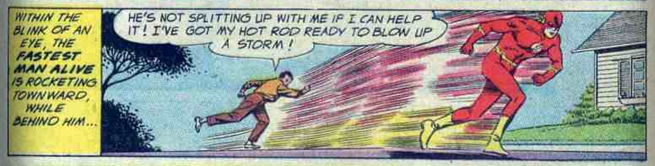
Last Friday I posted something talking about the Flash and the different artists that worked the book in the 1970's and 1980's. The post was mainly about the art and I had hoped to pull off something fancy by showing a similar theme, in this case the Flash running, and how different artists depicted it. One artist would use speed lines and one would use different 'after images' of the Flash and one would just get crazy with it the older he got.

My twelve-year-old son Ashton didn't get it.

"I didn't like today's blog, Dad." He started. In all unfairness, he hasn't liked any of my blogs yet. I don't think he likes the idea of me blogging. "I get that you were trying to show the different artists on Flash, but you should have talked about the things that made them different."


Fair enough. I thought I was writing a little too much, and a more visual post would break the routine. Still feeling my way around this blog thing. However, last week's post was just a primer for this post.

As I said last week, I recently finished a re-read of the Flash. Every appearance outside of the Justice League for the Barry Allen version of the Flash, from 1956 to 1985. I enjoyed it immensely, as these straight-runs are a thing for me. And this Flash will always be the true Flash for me. I think that sort of thing is determined by one's childhood.


Much has been said about how Superman and Batman have been able to change themselves over the decades to appeal to the widest audience possible. Superman going from the anti-authority figure in the 1930's, Nazi fighter in the 1940's, super authority figure in the 1950's, and ending up a thorough square in the 1960's. A little lost in the culture. Once you've hit 'super authority figure', it's hard to come back from that with the hippies. But he did.

Not much has been said about other heroes. They don't change as much. Probably because they don't stretch out into other media as much as Superman and Batman do.


Barry Allen started out in the fifties with a crew cut and very much an authority figure. He was a police scientist, working the forensics before it was cool. It took him until the early seventies to get a new haircut. But his personality was always very stiff. I've come to see him second only to Superman in his staunch beliefs on right and wrong.


What's most interesting to me here is how the book changed over the decades. There were only a few main writers for the Flash. Robert Kanigher and John Broome got things started in the 1950's. Gardner Fox joined them for some stories in the early 1960's. And Frank Robbins took over in the late 1960's with some stories by Mike Friedrich. But all these stories were very plot-driven. Done-in-one stories usually heavily routed in science fiction. It was obvious these guys had a story to tell, the Flash character and setting were just the tools to tell it.


Cary Bates wrote his first Flash story in May of 1968. He was the first Flash writer who grew up as a fan of the character. He wasn't telling stories that just happened to have the Flash in them. He was definitely writing the Flash. He took over the book as regular writer in 1973. He continued as regular writer for the Flash until the book was cancelled in 1985. For the decades of the 1970s and 1980s he controlled the Flash's destiny. And these stories were very different between the two decades, despite having the same writer.


This is the first time one of my re-reads has turned up something like this. Usually such a dramatic shift in story is because of a different writer coming in. In this case, I think it was editorial direction.


In the 1970s, Bates wrote short, action packed, done-in-one-issue stories. Conflict was the main thrust of the story, rather than plot. Not violence by today's standards, but definite action. These were obviously reaching out to a young audience of bike-riding kids at the 7-Eleven looking for something fun to spend their thirty-five cents on.


In the 1980s, Bates' stories changed drastically. He started adding more drama, and the stories started stretching over multi-issue story arcs. The Flash's wife died, right after they decided to start having kids. The Flash took several issues to find out who the real killer was and resolve the murder. He moved, got neighbors and new supporting cast members, started to actually be depicted at his job at the police station, and started to date. Then, after meeting and romancing another woman, he was about to marry again when the same villain who murdered his first wife showed up and tried to do it again. During the ensuing battle, Flash snapped the villains neck and killed him instantly.


The trial of the Flash was unprecedented in comics, stretched over two years or so, and turned out to be quite boring. I give Bates props for the ambition. If he was being told to ramp up the drama, he did that quite a bit.


These stories were not written for the casual reader. They were written for the repeat buyers showing up in the new comic book stores that had started to pop up. These customers were a little older than the bike-and-convenience-store crowd.


It was neat to stumble upon this example of the comics actually trying to change themselves to meet the needs of their greatest comic audience. However, I do believe this ultimately led to their downfall. In the 1940's, comics were for kids and sold everywhere and a single issue could sell in the millions. Today, finding comics appropriate for kids is tough, they're only sold in specialty shops, and the companies are happy with book that sells in the tens of thousands.

It's more complex than that. With price and competing entertainment factoring in. All I know is that I miss being able to hop on my bike and peddle down to the 7-Eleven to see what's on the spinner racks and maybe get a piece of candy for the bike ride home.

Thanks,
DCD

Friday, July 6, 2012

Artistic Differences - Flash

Folks,

One of the series that I want to run on this blog is a look at how a particular character can be vastly different depending on the decade in which he's depicted.  Superman and Batman are the clear leading examples, and much has been written about that.

But other than attitude and depiction, there's art.  While I'm not an artist, I am highly intrigued by art and different art styles.  I began to recognize different art styles at a very early age.  When I realized this guy 'Kirby' made things look different from EVERYONE else.

I've also just completed a read of the Silver Age Flash, Barry Allen.  Every appearance from the first in 1956 to the last issue of his series in 1985.  It was fun, and I love reading a character straight through like that.  But with the Flash, the differences between the different decades was made quite apparent to me.

I'll get to that later.  For now, let's check out some art.  Just for fun.

Flash had five different main artists on his book from 1956 to 1985.  His originator, Carmine Infantino.  Carmine's successor Ross Andru.  My favorite and the artist I associate with Flash from my childhood, Irv Novick.  Don Heck, who I recognize as a classic but has never been one of my favorites.  And then in the 1980's, Carmine Infantino came back again.  This time with a looser style and much more confidence, having been DC's editor in chief in the meantime and probably having hired the editor that was overseeing him.

Carmine's pencils are widely recognized as one of the industry greats.  I love his stuff from the sixties.  As a kid, I wasn't too fond of his Spider-Woman or Star Wars work in the seventies.  And as a teenager in the eighties I had no appreciation for Carmine at all.  I guess I just didn't have the perspective I have now.  But the 1980's were all about George Perez, John Byrne, Keith Giffen, and Jerry Ordway for me.  Highly detailed artists.  Carmine is more fluid.  And if he has the wrong inker, he was a mess.

ANYWAY... just my opinion.  Here are some shots.

Carmine Infantino; 1965


 Ross Andru; 1968

 Irv Novick; 1978

 Don Heck; 1981

Carmine Infantino; 1983

Other artists had a crack at Flash when he made appearances in the Brave and the Bold and, of course, Justice League of America.
Neal Adams; 1968
Jim Aparo; 1976
Mike Sekowsky; 1960
Dick Dillon; 1979
George Perez; 1981


Thanks,
DCD